-

-
-
Loading
Loading

JAKARTA — For decades, developing nations have often been trapped in what political economists call the "Extractive Compromise." In this system, the stability of daily consumer goods prices and the illusion of public purchasing power are maintained through waves of cheap imports. However, behind the scenes of this pseudo-stability, the nation's structural wealth—minerals, marine resources, and energy—is quietly siphoned off through underinvoicing, transfer pricing, and royalty cuts at export ports.
Now, a new economic blueprint is formulating a systemic resistance against this extractive capitalist model. This new paradigm aims to shift the state's orientation toward a "Pancasila Economy," an integrated system that places village independence at the epicenter of growth.
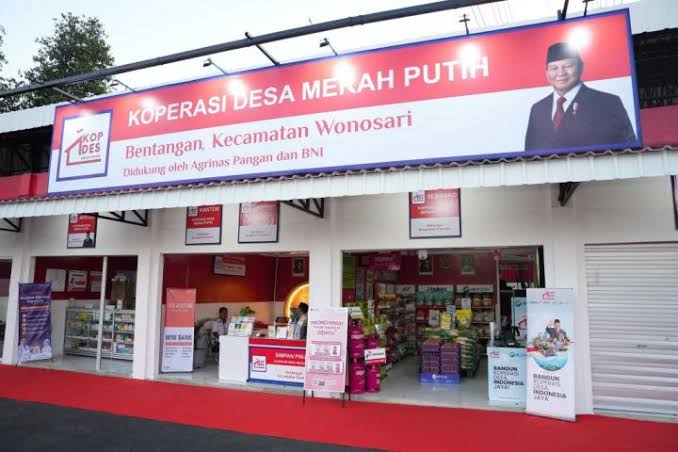
The primary instrument for altering this roadmap rests on two interconnected giant pillars: The Daya Anagata Nusantara Investment Management Agency (Danantara) at the macro (upstream) level, and the Red and White Village Cooperatives (Kopdes Merah Putih) at the micro (downstream) level.
Closed-Loop Value Chain Architecture
To break the cycle of dependence on extractive foreign capital flows, policymakers project Danantara and Kopdes Merah Putih to operate within a single, intact, and closed national value chain.
Upstream, Danantara will act as the bulwark of state wealth (Sovereign Wealth). This agency will hold stewardship over the export of primary commodities such as nickel, crude palm oil (CPO), bauxite, and marine products. Ending the era of raw private receipts that are prone to manipulation, Danantara will implement a Digital Trade Ledger—an integrated smart contract system that locks in international reference prices to eliminate underinvoicing loopholes.
Furthermore, all resource rents or extraction profits from natural resources will no longer be parked in tax havens. These profits will be retained domestically as "patient capital," specifically reinvested to fund rural technology and infrastructure.
Downstream, Kopdes Merah Putih will take over the role as the engine of production and distribution. This concept promises collective land reform; agricultural and fishery lands will no longer be dominated by large corporations, but consolidated under cooperative management with a fair profit-sharing scheme.
Kopdes is also designed to eliminate the monopoly of private middlemen. The cooperative will act as a guaranteed off-taker, absorbing the residents' harvests at upper reference prices. These products are then channeled directly to the national market or strategic government programs, such as the Free Nutritious Meals initiative.
The 15-Year Roadmap: From Consolidation to Total Independence
The transformation from extractive capitalism—where capital is concentrated among a 1% oligarchy and foreign entities—to an economy where wealth is distributed through the villagers' Cooperative Dividends (SHU), admittedly cannot happen overnight. This blueprint formulates a 15-year transition roadmap divided into four crucial phases:
Phase I (Years 1–3): Digitalization and Plugging Leaks. The primary focus is Danantara's takeover of export flow control via blockchain technology, and the launch of Kopdes pilot projects in 10,000 food-base and coastal villages.
Phase II (Years 4–7): Rural Industrialization. State-Owned Enterprise (SOE) dividends and royalties will begin to flow to build sub-district level Local Processing Hubs, such as cold storage and drying facilities. Kopdes takes full control over production inputs (fertilizer, seeds) to eliminate distribution mafias, prioritizing domestic market fulfillment over exports.
Phase III (Years 8–10): Food and Energy Sovereignty. Villages transition into independent energy producers (micro-hydro, biomass). Village social security begins to be funded independently from Kopdes surpluses and Danantara capital injections, leading to the total elimination of staple food imports.
Phase IV (Years 11–15): Total Independence. The peak of the transformation, where Indonesia fully transitions into an exporter of finished goods. Villages cease to be mere providers of cheap labor for urbanites, evolving into centers of growth with high per capita income. The State Budget (APBN) is projected to be freed from foreign debt, relying instead on the dividends of this closed-loop economic ecosystem.
Guardrails: Mitigating the Risk of Failure
However, political economy analysts offer a critical note. Without strict governance, this hybrid model carries a high risk of slipping into a bureaucratic, sluggish, and corrupt State Capitalism.
To mitigate these risks, this architecture mandates two absolute conditions. First, Digital Governance and Open Auditing. All transactions between Danantara and Kopdes must utilize a decentralized accounting system (open ledger), ensuring every villager can track the flow of funds and dividend margins in real-time from their mobile phones.
Second, Professional Management Autonomy. Managerial positions in Kopdes Merah Putih must be immune to political intervention. Cooperative managers are prohibited from being political party elites or local officials. They must be professionals recruited and paid based on strict Key Performance Indicators (KPIs), measured exclusively by the growth of SHU and the real welfare improvement of farmers and fishermen in the village.
If executed with precision and uncompromising discipline, the synergy between Danantara and Kopdes Merah Putih will not only dismantle the "extractive compromise" in Indonesia but also holds the potential to become a new economic blueprint for the Global South.